
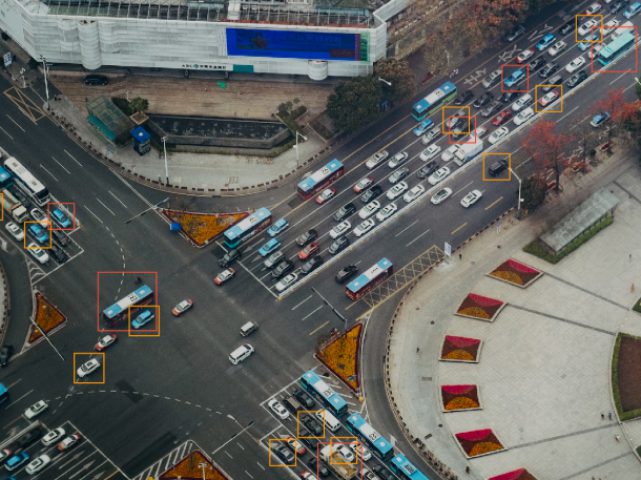
We work on every image with focus & attention to ensure every pixel is covered with perfection. Our vast experience in Image Annotation helps you to quickly & accurately use the annotated data to train AI / ML models to track & predict the behaviour of different elements (objects, faces etc.) within the image.
2D Bounding
Box
Our experts can draw & label 2D bounding boxes around the necessary objects in your images or videos. This helps in improving object detection in autonomous vehicles, drones, traffic detection etc. Our expertise & experience ranges from the Auto Industry to Agri-tech & Gaming.
Cuboid
Annotation
To process 3D data, we label objects in images & videos using Cuboids. This technique is used in both 2D images & 3D point cloud data. Use our 3D Cuboid annotation service to train object recognition in self-driving vehicles & other complex projects.
Key Point &
Landmarking
Keypoint & Landmark annotations are used to identify shape variations & detect small objects. By accurately plotting a sequence of points, our experienced annotators ensure highly accurate annotation results to train machines to recognise smaller objects & their attributes.
LiDAR
Annotation
Light Detection & Ranging is a remote sensing method that uses light in the form of a pulsed laser to measure ranges & is used by many self-driving vehicles to sense the surroundings. We annotate 3D data collected by LIDAR cameras in the form of light points.
Polygon
Annotation
Annotating Polygons is a precise way to annotate objects by including only the pixels that belong to them. Polygons are most useful for training object localization & detection algorithms. They are used in annotations to medical image data & in natural data related to scene text.
Polyline &
Spline Annotation
Polyline techniques help create ML models for computer vision to guide autonomous vehicles. Our annotators label the lane using line or spline annotation techniques. This makes the ADAS system on self-driving cars easily recognize the roads, ensuring safe driving.
FSL & Semantic
/ Annotation
With pixel-by-pixel annotation, semantic segmentation assists the AI-based perception model in classifying & detecting the objects of interest. To create the segments that your computer vision algorithm needs, our team annotates each and every pixel of an image.
Image
Categorization
By using precisely categorized photos & image classification procedures that ensures accuracy while removing any human bias or errors, we supply your computer vision models with reliable ground truth data. Our employees are multilingual experts.
Pose
Estimation
Used in a series of images, this technique detects & tracks facial features, expressions, emotions, body parts & poses. This is done by looking at a combination of the pose and the orientation of a given person / object.
Data Insights Are Posted Right Here.

The Lakers won the NBA playoffs thrillingly beating the Miami Heat in an NBA season like no other in the history......

Sports Analytics is a collection of relevant historical statistics that when applied in the right way, can provide......

Neville Patel – A Visionary In The Data Annotation Industry. Artificial Intelligence and Machine Learning are revamping the way…